Why Is This Document Being Made Public? I did everything I could to avoid making the audio recordings and their transcripts public. The complete documentation of this case was sent to 306 recipients, including media organizations, government authorities, members of Parliament, and political figures. My objective was for the case of an innocent private investigator being held in custody, together with the available evidence, to be subjected to a thorough and meaningful examination. That did not happen. As no meaningful action was taken, I have no other choice but to publish the recordings and their transcripts in order to protect ourselves. A video summary of the case has been scheduled for automatic publication on a U.S.-based server, and the full documentation has also been submitted to several international news organizations, including BBC News and CNN.
BACKGROUND TO THE ARREST
On 6 May 2026, private investigator Kevin Szabó was taken into custody by a tactical police unit, despite being innocent, as the result of what is described as a fabricated criminal proceeding. His pre-trial detention was subsequently ordered by the court.
According to the official account, during an information-gathering operation conducted on 21 April 2026, the private investigator falsely identified himself to the father of a witness as an investigator from the Regional Prosecutor's Office of Investigation in Debrecen. The authorities further allege that, with the consent of both the girl's father and her class teacher, he transported the father's 16-year-old daughter to her father's workplace. Investigators classified this conduct as an unlawful restriction of personal liberty. However, these allegations are contradicted by the available audio recordings.
However, a chronological analysis of the available documents, police records, audio recordings, and other evidence raises a far more serious question that cannot be left unanswered.
Was Kevin Szabó's detention genuinely based on the offences alleged by the authorities, or was it prompted by the fact that he had obtained information and evidence that could expose police failures, possible corruption, and indications of an attempted cover-up in the investigation of a suspected child sexual abuse case?
This article does not seek to determine Kevin Szabó's criminal liability. Its purpose is to present, on the basis of the available documentation, the sequence of events that led to his arrest, the investigative shortcomings identified in the case he was examining, and the circumstances that raise questions as to whether the real motive behind the authorities' actions differed from the reasons officially presented.
At the centre of this case is a criminal investigation in which, as early as June 2024, police had received information giving rise to suspicions that a trainee teacher may have committed sexual offences against children. According to the available records, however, significant delays and investigative failures allowed the suspect to remain at liberty for almost nine additional months.
In 2026, private investigator Kevin Szabó began examining the circumstances surrounding the case. According to Mónika Juhász, the evidence uncovered during this review suggested not only professional failures but also circumstances that could indicate an attempt to conceal a case involving child victims. Thereafter, private investigator Kevin Szabó, who was investigating the alleged police failures and the background of the case, together with Mónika Juhász, whom the authorities treated as his accomplice, became the target of criminal proceedings and an exceptionally intensive law enforcement operation.
Based on the chronology presented below, readers may draw their own conclusions as to whether these events were merely a series of coincidences.
WHAT DID THE POLICE KNOW IN JUNE 2024?
During the investigation, a number of circumstances emerged that raise serious questions about the professionalism and thoroughness of the police investigation.
Based on the available police records, there appears to be no professional justification for why the Sárospatak Police Department initiated criminal proceedings on 10 June 2024 solely on suspicion of child endangerment, or why the trainee teacher was not taken into custody until nearly nine months later.
At 10:18 a.m. on 7 June 2024, an individual identifying themselves as "A Concerned Parent" sent an email to the director of the school district. Among other things, the email stated:
"There is one more matter which, as a parent, I believe is absolutely essential to investigate. A teaching assistant at the school has developed inappropriate relationships with several female students, to the point where semi-nude photographs were exchanged via Messenger. The headmistress has reportedly been aware of this for some time, but I do not know whether she has taken any action to address the situation."
Four hours later, at 2:06 p.m. on 7 June 2024, the school's headmistress informed the director of the school district by email of the serious allegations that had emerged within the school. According to the email, one of the school's young teachers had been regularly communicating with several students via Messenger and Snapchat, with conversations sometimes continuing until late at night or into the early hours of the morning.
The principal’s report also noted that, according to the students’ accounts, the teacher asked a minor student to send a photo of herself in her underwear and sent another student a photo depicting his own genitals. According to the report, he also called three female students into the upstairs restroom and told them, “If you want more than just a kiss, you can go into the restroom.”
On June 10, 2024, the Sárospatak Police Department launched an investigation based on a complaint filed by a parent. According to the complaint, the student teacher sent images depicting his own genitals, as well as messages of a sexual nature, to the parent’s seventh-grade child via Messenger. The parent submitted the available digital screenshots to the investigating authorities in electronic format.
On the same day, investigators interviewed another minor. Two days later, on 12 June 2024, a third girl was also questioned. At that time, she denied that anything inappropriate had occurred between her and the teacher.
Although the police had multiple victim statements, digital evidence, and the school's official report from the very beginning of the investigation, the headmistress was not interviewed until 6 March 2025—almost nine months later. According to the available case files, no other members of the school's teaching staff were interviewed during the early stages of the investigation.
MISSED INVESTIGATIVE STEPS
On 10 June 2024, investigators carried out a search of the teacher's residence in an attempt to locate digital storage media and electronic devices. The search, however, yielded no results.
According to the case files, the authorities were already in possession of a photograph that the teacher had taken of his own genitalia and sent to the minor victim. The distinctive red-and-white checkerboard floor visible in the image, together with other features of the room, matched the bathroom inspected during the search. Despite this, no crime scene examination was conducted, no forensic photographs were taken, and the available records contain no indication that investigators attempted to document this apparent match.
The location was ultimately identified not by the authorities, but by private investigator Kevin Szabó nearly twenty-two months later. During his independent investigation, he identified the bathroom in which the photograph of the teacher's genitalia, sent to the minor victim, had been taken.
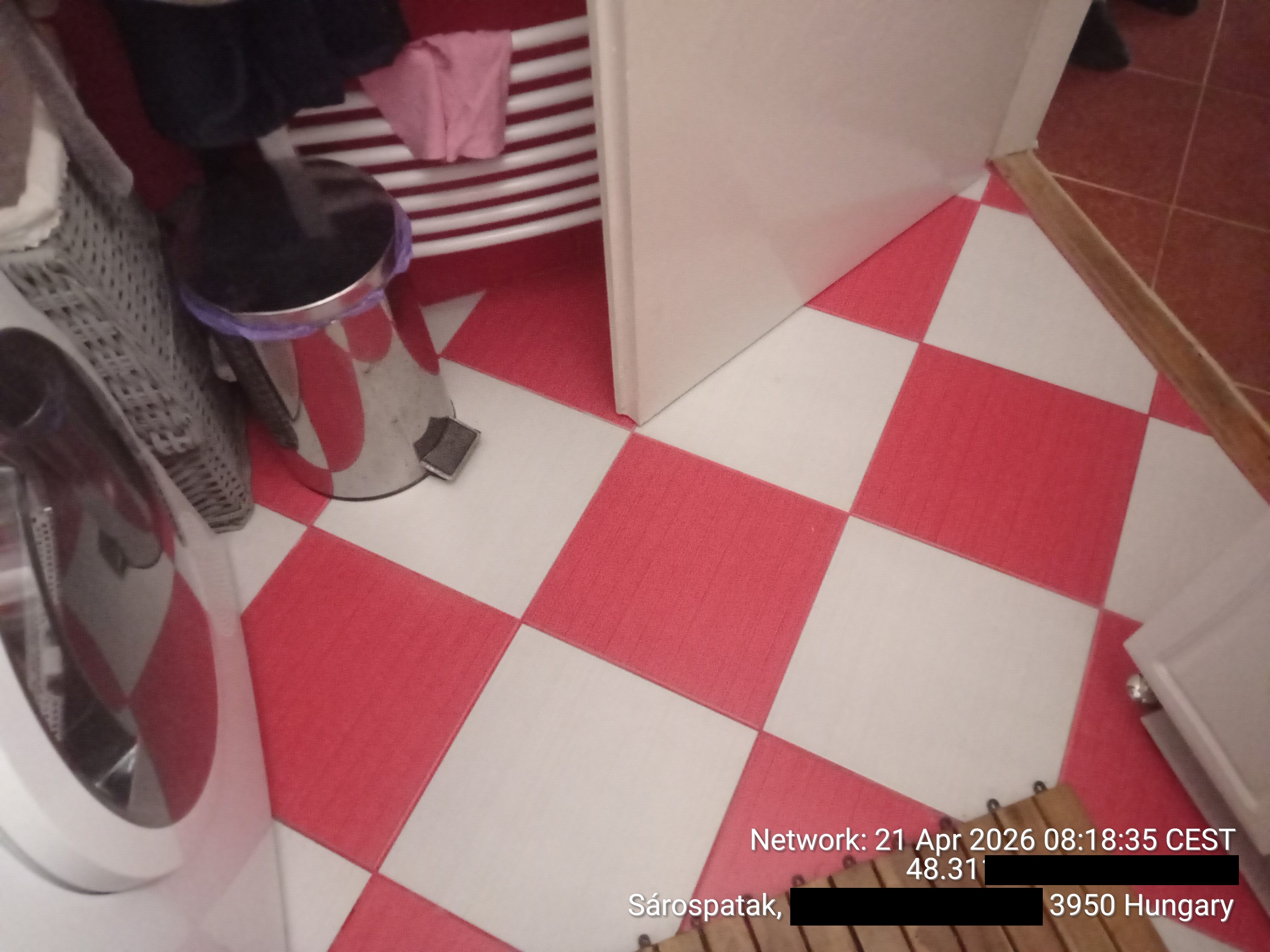
According to Mónika Juhász, the conditions observed at the scene, together with the available photograph, indicate that the correspondence between the image and the teacher's bathroom could already have been examined and documented at that time.
It is particularly difficult to explain why, despite possessing digital evidence, victim statements, and an apparent match between the photograph and the location, the authorities failed to carry out investigative measures that would have ensured the prompt, professional, and comprehensive documentation of this evidence.
It is also of particular concern that the colour digital evidence in the authorities' possession was not disclosed to the defence for nearly two years, despite repeated requests. According to the available documents, the evidence was released only during the week following Kevin Szabó's detention.
The significance of these investigative omissions is further underscored by the fact that, despite the available evidence, the suspect remained at liberty for almost nine additional months.
According to Mónika Juhász, one of the most serious shortcomings of the investigation was that, although the allegations were based primarily on digital communications between the teacher and the minor victims, the authorities never seized the victims' mobile phones or any other electronic devices.
In her view, the children's devices could have contained original message exchanges, photographs, metadata, and other digital evidence of significant evidentiary value. In a suspected child sexual abuse case, preserving such evidence would have been essential and at least as important as locating and examining the electronic devices used by the suspect.
However, based on the available case files, the investigative authorities did not seize the victims' digital devices, and consequently their contents were never comprehensively and promptly preserved.
Further questions arise from the fact that a search of another property associated with the teacher was not carried out until the following day. During that search, investigators seized a mobile phone and a laptop, which were later examined by digital forensic experts at the Miskolc Institute of the Hungarian Institute for Forensic Sciences (NSZKK). According to the available records, the forensic examination ultimately failed to uncover digital evidence incriminating the suspect.
The significance of the one-day delay lies in the fact that the authorities were already in possession of the information contained in the criminal complaint, victim statements, and the available digital evidence. Under such circumstances, postponing the search created a genuine opportunity for the suspect to delete, alter, or otherwise destroy relevant digital evidence.
Taken together, the documented investigative omissions, delays, and the authorities' apparent inaction despite the available evidence raise questions that extend beyond the possibility of mere professional error. The authorities possessed information that warranted the immediate preservation of evidence and prompt clarification of the allegations, yet several fundamental investigative measures were either omitted or carried out only after significant delay.
It is particularly difficult to explain why, while investigating suspected sexual offences against a minor, the authorities failed to properly document the scene, compare the available evidence, seize the victims' digital devices, and prevent the possible destruction of additional digital evidence.
Based on a chronological analysis of the case file, there are reasonable grounds to question whether the investigative omissions and delays were merely the result of professional mistakes. Taken as a whole, the available information, victim statements, and digital evidence do not provide a satisfactory explanation for why several fundamental investigative steps were omitted and why meaningful progress in the investigation was delayed for almost nine months.
NINE MONTHS WITHOUT MEANINGFUL PROGRESS
According to the available documentation, following these initial investigative steps, the Sárospatak Police Department carried out no significant investigative actions for an extended period that would have advanced the case. The investigation effectively stalled for months, despite the fact that the allegations involved minor victims.
The delays are illustrated by the fact that two of the minor victims were not subjected to gynecological examinations until several months—and, in one case, more than a year—after the alleged events. According to the available case files, one examination took place on 12 December 2024, while the other was conducted on 3 July 2025. Delays of this magnitude are particularly difficult to reconcile with the need for prompt and thorough evidence gathering in an investigation involving suspected sexual offences against children.
THE VICTIMS' FAMILIES RAISE CONCERNS
The prolonged investigation and the apparent lack of meaningful investigative action also became a source of concern for the victims' parents. During a recorded conversation on 21 April 2026, one parent stated:
"Everyone knew that the boy's mother and father would use their influence... I don't know if you're familiar with Wienerberger, but the father holds a senior position there. In my opinion, they tried to cover this case up by every possible means. They had a very good relationship with two police officers, and that's why the case remained stalled in Sárospatak for so long."
Another parent recalled that a police officer who later took over the investigation had also referred to shortcomings in the earlier stages of the case:
"That female police officer from Miskolc—I can't remember her name now—the one who took over the case..."
K: Tündi?
"I think so. She was very kind. She interviewed my child, and then interviewed her again later. She told me that, unfortunately, many things had been mishandled. We were so relieved when she took over because, for the first time, we could see that the investigation was finally moving forward. Before that, nothing had happened at all. People were genuinely afraid that he would get away with it. I said, 'No way. If necessary, I'll hire a lawyer.'"
These statements do not, by themselves, prove corruption or improper influence. However, it is noteworthy that the victims' families, independently of one another, raised the same concerns: the prolonged investigation, the lack of meaningful investigative action, and their fear that the case might ultimately end without consequences. Their statements take on added significance in light of the available police records, which indicate that the investigation made virtually no meaningful progress for several months, despite the authorities possessing information from the outset that could have justified prompt and decisive investigative action.
THE EVENTS BEGIN TO ACCELERATE
Following the conclusion of the police investigation, on 21 April 2026, private investigator Kevin Szabó, in the continuous presence of Mónika Juhász, began an independent fact-finding investigation into the case.
As part of this investigation, they contacted several of the victims who had previously been interviewed by the police, as well as witnesses and other individuals connected to the case. The purpose was to gather additional information and clarify inconsistencies found in witness statements, evidence, and other available information.
The primary objective of the investigation was to verify the original message exchanges, digital evidence, and other relevant circumstances, as well as to reconstruct the actual sequence of events. Particular attention was also given to examining how the shortcomings and delays in the official investigation may have affected the discovery of the facts, and whether any evidence or witness information had not been properly evaluated during the authorities' investigation.
As the investigation continued to stall, the victims' parents became increasingly frustrated. In an audio recording made on 21 April 2026, one of the parents stated:
"Well, I'll wait one more year at most. Then this whole case will be made public, and we'll see whose ass gets kicked."
This statement illustrates the growing frustration experienced by the victims' families as a result of months of investigative inactivity.
On 8 November 2024, Investigator Zsuzsanna Nagy interviewed Victim No. 3 at the Sárospatak Police Department. According to the official interview record, the investigation was still being conducted solely on suspicion of child endangerment, despite the victim stating the following during her interview:
“At first I thought he was going to scold me for not paying attention in class, but he told me to pull down my pants... He started stroking my pussy. He was just stroking me on the outside, but he also touched my breasts and my butt.”
On November 12, 2024, the father of Victim No. 3 filed a complaint with the Miskolc Police Department regarding a suspected sexual offense committed against a person under the age of twelve. An investigation was launched following the report.
On November 18, 2024, a forensic psychologist interviewed the three minor victims. At that time, the expert examination was still being conducted exclusively within the framework of the ongoing proceedings for the crime of endangering a minor. However, according to the available transcript, Victim No. 4 had already made statements at that time suggesting sexual assault.
The gynecological examination of Victim No. 3 did not take place until December 12, 2024, while the examination of Victim No. 4 did not take place until July 3, 2025. The timing of these examinations clearly illustrates the significant delays observed during the investigation.
On 10 January 2025, Chief Investigator Captain Dr. Tünde Kovács of the Borsod-Abaúj-Zemplén County Police Headquarters interviewed Victim No. 3 on suspicion of sexual assault involving a child under the age of twelve.
On 18 February 2025, the criminal proceedings were formally consolidated, resulting in the transfer of the investigation from the Sárospatak Police Department to the Investigation Division of the Borsod-Abaúj-Zemplén County Police Headquarters. The order was issued by Chief Investigator Captain Dr. Tünde Kovács and Head of Department Lieutenant Colonel Dr. Lajos Korpás.
According to the available records, by that stage the investigating authorities already possessed multiple victim statements, digital evidence, forensic expert opinions, and other evidence. Despite this, the two investigators still did not consider it necessary to request a coercive measure restricting the suspect's personal liberty. As a result, the trainee teacher remained at liberty until 10 March 2025.
In contrast, following the lawful information-gathering activities carried out by private investigator Kevin Szabó, the Sárospatak Police Department and the Borsod-Abaúj-Zemplén County Police Headquarters launched an exceptionally rapid and intensive operation against him and his alleged accomplice, Mónika Juhász. According to the authorities, the private investigator falsely identified himself as an investigator of the Regional Prosecutor's Office of Investigation in Debrecen and, together with his alleged accomplice, Mónika Juhász, transported a 16-year-old girl to her father's workplace with the consent of both her father and her class teacher. The authorities classified this conduct as unlawful deprivation of personal liberty. Mónika Juhász, however, maintains that the available audio recordings clearly refute these allegations and that the authorities nevertheless failed to take this evidence into account. According to Mónika Juhász, the authorities' primary objective was to silence Kevin Szabó, obtain and seize the evidence he had gathered, and cover up a suspected child sexual abuse case.
The situation becomes even more significant given that the same investigating officers—Chief Investigator Captain Dr. Tünde Kovács and Head of Department Lieutenant Colonel Dr. Lajos Korpás—were once again responsible for the proceedings. These were the same officers who had previously played key roles in the suspected child sexual abuse case and whose earlier decisions allowed the original suspect to remain at liberty until 10 March 2025.
The chronology of events reveals a striking difference in the authorities' response to the two cases. While, in the suspected child sexual abuse case, no measure restricting the suspect's personal liberty was taken for months despite the available victim statements and digital evidence, the response following Kevin Szabó's information-gathering activities was immediate. On the very same day, investigators began interviewing witnesses and collecting CCTV footage. The following morning, police officers carried out an operation at the homes of Kevin Szabó and Mónika Juhász, followed by several weeks of surveillance by both the police and the Counter Terrorism Centre (TEK). Finally, on 6 May 2026, the private investigator was taken into custody during an operation involving a tactical police unit.
On 5 and 7 March 2025, further searches were carried out at properties associated with the teacher, and nearly nine months after the original allegations first emerged, the authorities finally ordered his detention.
According to the available documentation, Kevin Szabó subsequently expanded his investigation beyond the circumstances of the alleged offences themselves to include the investigative shortcomings identified by the victims' families and the circumstances surrounding the alleged attempted cover-up of the case.
THE CHRONOLOGY OF EVENTS
The sequence and timing of the events are particularly noteworthy and are illustrated in detail in the following chronology. The timeline below summarizes the events relating to private investigator Kevin Szabó and Mónika Juhász.
On 21 April 2026, between 8:00 a.m. and 3:10 p.m., private investigator Kevin Szabó, accompanied throughout by Mónika Juhász, gathered information from witnesses and other individuals who had previously been interviewed by the police. The purpose was to clarify inconsistencies that had emerged in the case and to locate the original digital evidence.
Audio recordings that assist in reconstructing the events—including telephone conversations between Chief Investigator Captain Dr. Tünde Kovács, the father of Victim No. 4, and Kevin Szabó, as well as relevant excerpts from conversations with the individuals they interviewed—can be heard in the following video: [Facebook link].
Later that same day, the police, acting in immediate response, began interviewing the individuals who had been contacted by Kevin Szabó and Mónika Juhász, a process that is documented as having started at 4:14 p.m. The authorities also began collecting CCTV footage from public surveillance cameras. The speed of these actions demonstrates that, in this instance, the authorities were able to mobilize substantial resources and carry out targeted investigative measures within just a few hours.
This becomes particularly significant in light of the fact that, as described in this article, the investigation into the suspected child sexual abuse case was marked by the omission or substantial delay of several fundamental investigative measures, despite the authorities having access to victim statements, digital evidence, and other relevant information. The striking difference in the level of investigative activity between the two cases raises legitimate questions regarding the authorities' priorities, as well as the consistency and integrity of their investigative practices.
On 22 April 2026, following surveillance that began at 5:40 a.m., the police carried out an operation at their home at 7:08 a.m. During the operation, one of the attending police officers teased his colleagues to set the property on fire [link].
Between 22 April and 6 May 2026, they reported being under continuous surveillance by both marked and unmarked vehicles, as well as by a minibus bearing registration number AO DF-601, which neighbours identified as a vehicle belonging to the Counter Terrorism Centre (TEK).
On 27 April 2026, a man identifying himself as Miklós Bódis called private investigator Kevin Szabó on the ECHO Search and Rescue Group's telephone number from the number +36 20 960 0914. He claimed to be an employee of the National Protective Service (NVSZ) and asked questions concerning alleged police corruption. He also warned them that they should not be investigating police officers or publishing their photographs. Later that day, József Losonczi, the leader of the ECHO Search and Rescue Group, returned the call. An audio recording of that conversation is available here: [audio recording link]. In order to verify the caller's identity, József Losonczi also contacted the National Protective Service by email on the same day, requesting confirmation as to whether the individual identifying himself as Miklós Bódis was in fact a member of the NVSZ. A copy of that email is available here: [PDF link].
On 5 May 2026, one day before the tactical police operation, another telephone call was received from a number associated with the National Protective Service. The caller identified himself as Dávid Szabó and requested a return call.
On 6 May 2026, following aerial surveillance conducted with a drone, the police carried out a tactical operation involving a special intervention unit, during which a total of 38 electronic storage devices were seized. Kevin Szabó was taken into custody at 5:20 p.m., while Mónika Juhász was detained for questioning at 6:35 p.m.
UNANSWERED QUESTIONS
According to Mónika Juhász, Kevin Szabó subsequently became the target of the authorities' actions. In her view, the alleged threats to set their home on fire, the weeks of police and Counter Terrorism Centre (TEK) surveillance, and the subsequent tactical police operation cannot be regarded as isolated events. Rather, she believes they were connected to the fact that the private investigator had obtained information that could raise extremely serious questions regarding the handling of a suspected child sexual abuse case and the conduct of both the Sárospatak Police Department and the Borsod-Abaúj-Zemplén County Police Headquarters.
The official documents, audio recordings, and other available evidence raise numerous questions that remain unanswered regarding the conduct of the investigation and the handling of the case. At the same time, the available records show that, despite allegations involving serious offences against children, the investigation made little meaningful progress for several months, while a number of fundamental investigative measures were either omitted or carried out only after significant delay.
Based on the chronology of events, the documented investigative shortcomings, and the exceptionally intensive police and counter-terrorism response directed at Kevin Szabó—an approach that, according to Mónika Juhász, is virtually without precedent in comparable cases—she believes there are reasonable grounds to question whether the measures taken against the private investigator were motivated by the officially stated reasons, or by the fact that he had obtained information and evidence raising serious concerns about the handling of the suspected child sexual abuse case, the investigative failures, and the possibility of an attempted cover-up.
Ultimately, answering these questions is the responsibility of the competent investigative authorities, the prosecution service, and, ultimately, the courts. One conclusion, however, can already be drawn from the available documentation: both the proceedings against Kevin Szabó and the investigation into the suspected child sexual abuse case raise issues of such seriousness that they warrant a thorough, independent, and transparent examination as a matter of public interest. Furthermore, in my view, based on the facts presented, the continued detention of private investigator Kevin Szabó cannot be justified. His immediate release is therefore essential to prevent further violations of his constitutional and fundamental human rights.
According to Mónika Juhász, after what she considers to have been Kevin Szabó's unlawful arrest as part of a show trial, she repeatedly requested an investigation into the proceedings conducted against both herself and Kevin Szabó in connection with the underlying case, as well as a substantive investigation into the police failures and the suspected corruption they had uncovered. However, as no authority or Member of Parliament was willing to examine these matters, she was left with no alternative but to make public the transcripts of the audio recordings in her possession, together with the recordings themselves, which are available at the following link: [link].
According to Mónika Juhász, the audio recordings in the possession of the investigating authorities clearly refute the allegations made against both Kevin Szabó and herself, and the authorities are fully aware of this. In her view, in a state governed by the rule of law, no one should be deprived of their liberty when the investigating authorities possess evidence that contradicts the allegations against them. She further maintains that the police influenced witness testimony and that an independent investigation is required to determine how multiple witness statements containing virtually identical accounts came into existence despite contradicting the contents of the available audio recordings.
If you believe this case deserves public attention, please share this page.